Focus
AG Projects is an established supplier of real-time communications systems, in business since 2002. AG Projects' solutions were used primarily to replace classic telephony networks and to deliver collaboration and unified communications services for vertical markets with specific online-communication needs. Today they also serve as future-proof, open alternatives to closed walled-garden services such as WhatsApp and Telegram — covering the same everyday use cases (one-to-one messaging, voice and video calls, file sharing, presence) but built on open standards (SIP and WebRTC) and operated under the customer's own Internet domain rather than locked into a single vendor's silo. Group messaging is on our roadmap.
We develop, maintain and contribute to a wide range of software for real-time communications. Many of these projects are available as open source, including Blink, CDRTool, MediaProxy, MSRP Relay, OpenSIPS, OpenXCAP and SylkServer, together with general-purpose libraries for WebRTC, SIP, TLS, XCAP, MSRP and JSON.
Experience
Our experience covers signaling protocols, high availability, end-to-end encryption, addressing and numbering systems, provisioning, accounting and disaster-recovery planning. We design cost-effective infrastructures that scale easily and remain simple to operate.
What sets us apart operationally is that every solution we deliver is tested in production on the public Internet before it is deployed to the customer's environment.
We build long-term relationships with our customers: the average engagement lasts ten years.
Open-source approach
The building blocks of our work are open source. SylkServer, the SIP SIMPLE Client SDK, OpenXCAP, MSRP Relay, MediaProxy, CDRTool, Blink and the related libraries are all released under open-source licences, published on GitHub, with public release notes, issue trackers and mailing lists for both users and developers. Anyone can read the code, deploy it on their own hardware, and adapt it to their own needs.
Some of our integrated commercial offerings — most notably the SIP Thor platform — package these components into turnkey solutions with additional engineering, hardening and operational know-how. Even there the underlying parts remain open: customers can read the source of every component, and there is no proprietary "black box" hiding inside.
The choice is deliberate. Open source aligns the incentives between vendor and customer: the customer keeps control of their own infrastructure, can audit what they run, and is never blocked by a vendor that has lost interest, gone out of business or changed its licensing terms. For us, openness is also a discipline — when the code is public, the only path to a good reputation is to ship genuinely good code.
This approach keeps the company focused on what it does best. We don't license signalling stacks, media engines or cryptographic libraries from opaque third parties: the open standards we follow have open-source implementations that we either contribute to or maintain ourselves, end to end.
Our value is in architecture, scalability and integration — not in hidden components.
We deliberately chose the open-source path rather than the certification path, and we did so because we believe the two answer different questions.
A certification programme answers "does this product pass a closed test lab's check-list?" The check-list is private, the test lab is expensive, and the resulting badge is mostly useful as a procurement signal. Once a particular configuration is certified, any deviation — a security patch, a new codec, a different operating system — risks invalidating the badge, so vendors and operators tend to freeze their deployments around what was tested. In practice this hardens vendor lock-in.
Open source answers "does this product actually interoperate with the rest of the Internet, in the open, today?" Our products are implementations of public IETF standards (SIP, SDP, RTP, MSRP, XCAP, WebRTC, …). The contract is the RFC, not a private test plan: anyone can read the specification and verify our behaviour against it. Compliance is demonstrated by running on the public Internet — most visibly through the SIP2SIP service in production since 2005 — and by federating cleanly with other public SIP and XMPP domains.
For our customers the practical consequences are:
Auditability — the source code is available, so security and privacy assumptions can be verified rather than trusted.
Independence — there is no certified-configuration trap; operators can patch, extend and integrate without losing eligibility for support or future upgrades.
Faster iteration — fixes and new features ship on Internet timescales (weeks) rather than certification cycles (years).
Lower total cost of ownership — no certification overhead is embedded in licence fees.
A note on ISO/IEC 17020: that standard sets out the general criteria for the operation of inspection bodies — third-party organisations that inspect products, processes, services or installations on behalf of someone else. AG Projects is a software developer and infrastructure operator, not an inspection body: we build, ship and run the systems themselves rather than auditing the work of others. ISO/IEC 17020 is therefore not the appropriate yardstick for our deliverables; the applicable yardsticks are the underlying IETF and W3C specifications, and the day-to-day interoperability they enable.
We still take part in formal standardisation work where it matters — see the Public bodies section below — but we measure success by interoperation on the open Internet, not by paperwork from a closed lab.
Public bodies
AG Projects has been instrumental in developing and contributing to the success of several SIP standards.
SIP SIMPLE Working Group
AG Projects participated in the development of the standards and provided the first interoperable implementations of MSRP (client, focus, relay) and of XCAP clients and servers.
P2PSIP Working Group
AG Projects contributed operational feedback from the SIP Thor platform, which applies peer-to-peer SIP principles to deliver self-organising, horizontally scalable infrastructure. The working group, co-chaired by David A. Bryan and Cullen Jennings, defined the RELOAD protocol and the broader P2PSIP architecture that informed SIP Thor's design.
STOX IETF Working Group
The STOX IETF Working Group was chartered to standardise SIP/XMPP protocol interoperability. Feedback provided by SylkServer was instrumental to its standardisation efforts, originally started by P. Saint-Andre.
ETSI ENUM Task Force
AG Projects chaired the ETSI ENUM Task Force, which promoted the reuse of telephone numbers over the Internet.
SER Ecosystem
AG Projects helped promote the SER ecosystem and contributed as a management-board member to the OpenSER and OpenSIPS projects.
SIP Beyond VoIP
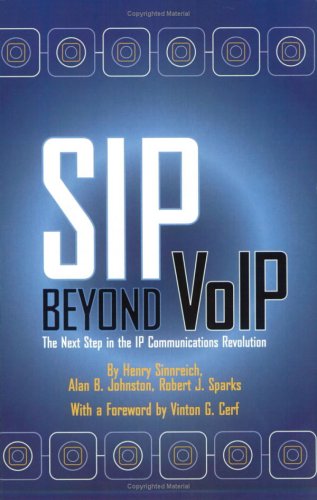
AG Projects is a follower of the SIP Beyond VoIP paradigm — the idea that SIP is a general-purpose framework for real-time communications well beyond plain telephony, covering messaging, presence, file transfer, conferencing and rich-media collaboration.
The paradigm was put forward by Henry Sinnreich, Alan B. Johnston and Robert J. Sparks in their book SIP Beyond VoIP — The Next Step in the IP Communications Revolution (with a foreword by Vinton G. Cerf). AG Projects was active in the VoIP revolution of the 2000s — building open-source server infrastructure and end-points around the IETF SIP family of standards — and has been humbled to accept the authors' mentorship over the years.
Many of the products we design and operate today — SIP Thor, Sylk Suite, the SIP SIMPLE Client SDK — are practical expressions of that wider vision, and we are grateful to the authors for mentioning us in their book.